Choosing the right TV service has become confusing. Some people prefer modern internet-based streaming, while others still trust traditional satellite TV. This is where the comparison of IPTV vs DTH becomes important.
IPTV (Internet Protocol Television) delivers TV channels through the internet, while DTH (Direct-To-Home) uses satellite signals. Both offer live TV, but the experience, cost, and features are very different.
In this guide, you’ll learn:
- What IPTV and DTH really are
- The key differences between IPTV and DTH
- IPTV reviews and DTH reviews based on real user experience
- A clear comparison table
- Which option is best for you in 2025
By the end, you’ll be able to make a confident decision without confusion.
What Is IPTV?
IPTV stands for Internet Protocol Television. Instead of using satellite signals or cables, IPTV streams TV channels using your internet connection.
How IPTV Works
IPTV sends TV content through the internet in real time. You simply install an app or player on your device, sign in, and start watching.
It works on:
- Smart TVs
- Android TV boxes
- Firestick
- Smartphones and tablets
- Laptops and PCs
Types of IPTV Services
There are three main types of IPTV:
- Live TV IPTV – Watch live channels like sports, news, and entertainment
- Video on Demand (VOD) – Watch movies and series anytime
- Catch-Up TV – Replay shows that already aired
Pros and Cons of IPTV
Advantages of IPTV
- Large number of channels
- International and regional content
- Lower monthly cost
- Works on multiple devices
- Includes VOD and catch-up features
Disadvantages of IPTV
- Needs stable internet
- Poor providers may cause buffering
- Legal status depends on the service
IPTV Reviews: Real User Experience
Based on user feedback, IPTV reviews often highlight flexibility and content variety.
What users like
- Thousands of channels from different countries
- HD and 4K streaming quality
- Affordable subscription plans
- Access to sports, movies, and TV shows
Common complaints
- Buffering with slow internet
- Some providers lack customer support
- Quality depends on the IPTV provider
Overall, IPTV reviews are mostly positive when users choose reliable services and have good internet speed.
What Is DTH?
DTH means Direct-To-Home television. It uses satellite signals to deliver TV channels directly to your home through a dish antenna.
How DTH Works
A satellite dish receives signals from space and sends them to a set-top box connected to your TV. No internet is required.
Who Uses DTH?
DTH is popular among:
- People in areas with weak internet
- Traditional TV viewers
- Elderly users who prefer simple controls
Pros and Cons of DTH
Advantages of DTH
- Stable signal in most cases
- Fully legal and regulated
- Easy to use
Disadvantages of DTH
- Limited channel packages
- High installation cost
- No video-on-demand
- Fixed location only
DTH Reviews: What Customers Say
DTH reviews often focus on reliability but also mention limitations.
Positive feedback
- Simple setup
- Clear picture quality
- Reliable service
Negative feedback
- Expensive monthly plans
- Long-term contracts
- Signal issues during heavy rain
- Limited international channels
DTH reviews show that while it is dependable, it lacks modern features.
What Is the Difference Between IPTV and DTH?
The main difference between IPTV and DTH lies in how content is delivered.
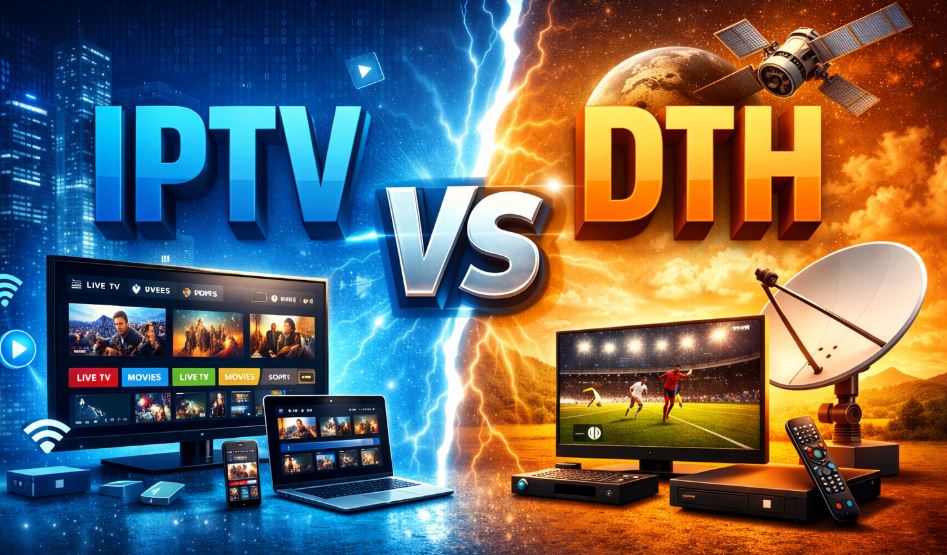
- IPTV uses the internet
- DTH uses satellite signals
- IPTV offers on-demand content
- DTH only offers live TV
- IPTV works on many devices
- DTH works only on one TV
This difference affects cost, flexibility, and viewing experience.
IPTV Uses the Internet
IPTV delivers TV channels through an internet connection. Instead of receiving signals from a satellite, IPTV streams content online, just like YouTube or Netflix.
As long as you have a stable internet connection, you can watch IPTV anywhere. The better your internet speed, the smoother the streaming experience.
DTH Uses Satellite Signals
DTH (Direct-To-Home) works through satellite signals. A dish antenna installed at your home receives signals from a satellite in space and sends them to your TV via a set-top box.
DTH does not require internet, but it depends heavily on weather conditions. Heavy rain or storms can interrupt the signal.
IPTV Offers On-Demand Content
One major advantage of IPTV is on-demand viewing. This means you can watch:
- Movies anytime
- TV shows whenever you want
- Missed programs through catch-up TV
You are not tied to a fixed broadcast schedule. You decide what to watch and when to watch it.
DTH Only Offers Live TV
DTH mainly provides live TV channels. You must watch programs at the time they are broadcast.
If you miss a show, there is usually no option to replay it unless you have an additional recording device. DTH does not include built-in video-on-demand features.
IPTV Works on Many Devices
IPTV is very flexible and works on multiple devices, such as:
- Smart TVs
- Android TV boxes
- Firestick
- Smartphones
- Tablets
- Laptops and PCs
You can switch devices easily and even watch IPTV while traveling.
DTH Works Only on One TV
DTH is designed for one fixed television. The set-top box is connected to a single TV, and you cannot watch it on your phone or laptop.
To use DTH on another TV, you usually need extra hardware and additional charges.
IPTV VS DTH Comparison Table (2026)
| Feature | IPTV | DTH |
|---|---|---|
| Technology | Internet-based | Satellite-based |
| Installation | App-based | Dish + Set-top box |
| Channel Variety | Very high | Limited |
| Video Quality | HD / 4K | Mostly HD |
| Monthly Cost | Lower | Higher |
| VOD & Catch-Up | Yes | No |
| Internet Required | Yes | No |
| Portability | High | Fixed location |
| Contract | Usually none | Long-term |
| Best For | Modern users | Traditional users |
IPTV VS DTH: Cost Comparison
When comparing IPTV vs DTH pricing, IPTV is usually more affordable.
IPTV Costs
- Low monthly fees
- No installation charges
- No expensive equipment
DTH Costs
- Installation and hardware fees
- Higher monthly plans
- Long-term commitments
Over time, IPTV offers better value for money.
IPTV VS DTH for Sports, Movies, and International Channels
Sports
IPTV provides:
- More sports channels
- International leagues
- Pay-per-view events
- All types of sports streaming you will watch from an IPTV provider. Like: StreamView IPTV, Zest IPTV, and Digitalizard.
DTH offers limited sports packages.
Movies and TV Shows
IPTV includes large VOD libraries with the latest content.
DTH does not offer on-demand viewing.
International Channels
IPTV supports channels from multiple countries, while DTH mostly focuses on local content.
IPTV VS DTH: Which One Should You Choose?
Choose IPTV If:
- You have fast internet
- You want flexibility and portability
- You like on-demand content
- You prefer lower costs
Choose DTH If:
- Internet is unreliable
- You prefer simple TV viewing
- You want a fully regulated service
Legal and Safety Considerations
IPTV can be legal or illegal depending on the provider. Always choose licensed IPTV services to stay safe.
DTH services are fully legal and government-approved.
Don’t miss knowing the related topics: IPTV VS YouTube TV
Future of IPTV and DTH
The future clearly favors IPTV. As internet speed improves worldwide, more users are switching from DTH to IPTV.
DTH usage is slowly declining, while IPTV continues to grow.
FAQs on IPTV VS DTH
What is better, IPTV or DTH?
IPTV is better for flexibility and content, while DTH is better for simplicity.
Is IPTV cheaper than DTH?
Yes, IPTV is usually more affordable.
Does IPTV work without internet?
No, IPTV requires internet.
Can IPTV replace DTH?
For most users, yes.
Is IPTV legal?
Legal if you choose licensed providers.
Conclusion: IPTV VS DTH – Final Verdict
The IPTV vs DTH comparison shows a clear winner for modern users. IPTV offers more channels, better features, and lower costs. DTH still works well for basic TV needs but lacks flexibility.
If you want a future-ready TV experience, IPTV is the smarter choice in 2025.