Buffering during the final minutes of a live match. Endless subscription options. Confusing terms like “Internet TV” and “IPTV” are plastered across every streaming guide. If this sounds familiar, you are not alone.
Although both Internet TV and IPTV deliver video content through an internet connection, they operate very differently under the hood. One prioritizes flexibility and device freedom. The other focuses on rock-solid reliability and broadcast-grade latency.
Understanding the difference between Internet TV and IPTV can save you hundreds of dollars per year and hours of frustration. In this guide, we will break down exactly how each technology works, explore the pros and cons of IPTV and Internet TV, and help you decide which one truly fits your lifestyle.
What Is Internet TV?
Internet TV refers to any video content delivered over the public internet using standard web protocols (HTTP/HTTPS). Unlike traditional broadcast or cable TV, Internet TV does not require a dedicated private network. Instead, it streams content from cloud-based servers to any device with a browser or app.
Common examples include:
- YouTube TV
- Hulu + Live TV
- Sling TV
- Amazon Prime Video
- Peacock
- Pluto TV (free)
How Internet TV Works
When you click play, your device requests small chunks of video from a content delivery network (CDN). The CDN sends those chunks over the same public internet you use for email, social media, and browsing. Because the network is shared, your experience depends heavily on your ISP’s bandwidth, network congestion, and your Wi-Fi quality.
Pros of Internet TV
- No long-term contracts – Most services operate month-to-month. Cancel anytime without penalties.
- Massive content libraries – Access thousands of on-demand movies, TV shows, and live channels.
- Device agnostic – Watch on smart TVs, smartphones, tablets, laptops, or gaming consoles.
- Free tiers available – Services like Tubi, Pluto TV, and Freevee offer ad-supported content at no cost.
- Portability – Take your subscription anywhere with an internet connection.
Cons of Internet TV
- Buffering and quality drops – During peak hours, video resolution may automatically decrease.
- Higher latency – Live sports often lag 30–60 seconds behind real-time, spoiling results if you follow social media.
- Data cap consumption – Streaming 4K video can use 15+ GB per hour, quickly exceeding some ISP limits.
- Fragmented content – Movies and shows are scattered across multiple services, requiring several subscriptions.
What Is IPTV?
IPTV (Internet Protocol Television) delivers television content over a private, managed network using quality of service (QoS) controls. Unlike Internet TV, IPTV does not compete with other internet traffic. The provider prioritizes video packets to ensure smooth, uninterrupted playback.
Important distinction:
There are two types of IPTV:
- Carrier-grade IPTV – Offered by telecom companies (Verizon Fios TV, Bell Fibe, T-Mobile TV). This is legal and reliable.
- Unverified IPTV services – Cheap monthly subscriptions from unknown providers. These often operate in legal gray areas and may shut down without notice.
How IPTV Works?
Your ISP reserves a portion of your connection exclusively for TV traffic. A set-top box decodes the signal and enables advanced features like pause-live-TV, restart shows, and catch-up TV. Because the network is managed, latency remains extremely low (2–5 seconds), and picture quality stays consistent.
Pros of IPTV (Carrier-Grade)
- Superior reliability – No buffering, even during prime time.
- Low latency – Ideal for live sports, stock trading, or news alerts.
- Consistent picture quality – Steady 4K or HDR without adaptive bitrate drops.
- Interactive features – Pause, rewind, and record live television.
- Integrated guide – Traditional channel-flipping experience with a program guide.
- Examples: Some popular IPTV services are: StreamView IPTV, Polu TV, TiviStation,
Cons of IPTV (Carrier-Grade)
- Expensive – Typically bundled with internet and phone services, starting at $80–$150+ monthly.
- Locked to provider equipment – Many require proprietary set-top boxes and remote controls.
- Geographic restrictions – Usually works only inside your home network (no roaming).
- Long-term contracts – Often require 1–2 year commitments with early termination fees.
- Limited device support – Cannot easily watch on a laptop while traveling.
Cons of Unverified IPTV Services
- Legal risks – Many stream copyrighted content without permission.
- Sudden shutdowns – Services disappear overnight, taking your prepaid subscription.
- Malware dangers – Unofficial apps and playlists may contain harmful code.
- No customer support – When something breaks, no one answers.
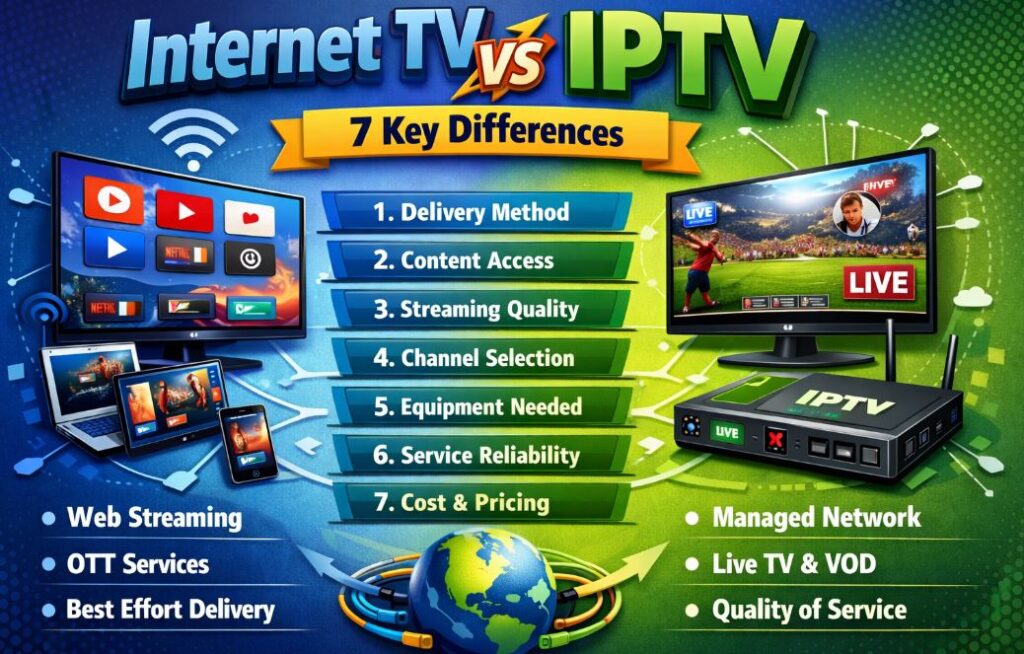
Internet TV vs. IPTV: Side-by-Side Comparison
| Feature | Internet TV | Carrier IPTV |
|---|---|---|
| Network type | Public internet (best effort) | Private/managed network (QoS) |
| Latency | 30–60 seconds | 2–5 seconds |
| Buffering | Common during peak hours | Extremely rare |
| Device compatibility | Any device with a browser or app | Proprietary set-top box or limited ISP app |
| Mobility | Works anywhere with broadband | Usually home network only |
| Contract required | No – month to month | Often 1–2 years |
| Monthly cost | $0–$80 | $80–$150+ |
| Content type | VOD + some live channels | Live TV, time-shifted, VOD |
| Picture consistency | Variable (adaptive bitrate) | Stable (constant bitrate) |
| Legal risk | None (licensed platforms) | None for carrier IPTV (high for unverified) |
Which One Should You Choose?
Choose Internet TV if:
- You travel frequently or watch on multiple devices.
- You want the freedom to cancel or switch services monthly.
- You primarily watch on-demand content (movies, series) rather than live events.
- You prefer using your own devices instead of renting a set-top box.
- You are comfortable with occasional buffering or quality drops.
Choose Carrier IPTV if:
- You are a hardcore live sports fan who cannot tolerate lag.
- You want a traditional channel-surfing experience.
- You have a fiber optic connection and prefer a single bill for TV + internet.
- You value zero buffering above all else.
- You rarely watch TV outside your home.
Avoid Unverified IPTV Services Because:
- Legal consequences – In some countries, streaming unlicensed content carries fines.
- Service instability – Channels go offline, EPG data disappears, and entire services vanish.
- Security risks – Unknown providers may log your viewing habits or inject malware.
- No warranty – You have no recourse if the service stops working tomorrow.
Frequently Asked Questions
Is YouTube considered IPTV?
No. YouTube streams over the public internet using HTTP, making it a form of Internet TV, not IPTV.
Can I use IPTV on my smart TV?
Only if your ISP provides a dedicated app for your TV model. Otherwise, you need their set-top box.
Which is cheaper – Internet TV or IPTV?
Internet TV is significantly cheaper. You can start with free ad-supported services and pay $40–$80 for premium live TV. Carrier IPTV typically starts at $80 and exceeds $150 with add-ons.
Is IPTV legal?
Carrier IPTV from telecom companies is completely legal. Unverified IPTV services selling hundreds of live channels for $10–$15 per month are almost always illegal.
What is the main difference between Internet TV and IPTV in one sentence?
Internet TV streams video over the public internet on a best-effort basis, whereas IPTV uses a private, managed network with guaranteed quality of service.
Does Internet TV work without a smart TV?
Yes. You can watch on a laptop, tablet, smartphone, or even a desktop computer. Some services also support gaming consoles like PlayStation and Xbox.
Conclusion
The choice between Internet TV and IPTV ultimately depends on your viewing habits, budget, and tolerance for technical hiccups.
Internet TV wins for flexibility, affordability, and device freedom. Most households will find services like YouTube TV, Hulu + Live TV, or Sling TV more than sufficient. The occasional buffering is a small price to pay for the ability to watch anywhere, cancel anytime, and use your own devices.
Carrier IPTV remains the gold standard for reliability and low latency. If you are a passionate live sports fan, a trader who needs real-time data, or someone who despises buffering with every fiber of your being, IPTV is worth the premium.
As for unverified IPTV services – steer clear. The risks far outweigh the savings.
Ready to cut the cord? Test your internet speed using the tool below, then compare three leading Internet TV providers against your local IPTV package. Your perfect setup is closer than you think.