In an era where digital entertainment dominates, streaming has fundamentally transformed how we consume media. Two terms sit at the heart of this revolution: OTT and VOD. While often used interchangeably, they represent distinct pillars of the streaming ecosystem. Understanding their differences is no longer just industry jargon—it’s essential knowledge for viewers, creators, and businesses navigating a trillion-dollar digital landscape.
This comprehensive guide demystifies OTT and VOD, exploring their unique characteristics, intersections, and how to leverage them for an optimized viewing or content strategy.
Understanding OTT: The Platform Revolutionizing Media
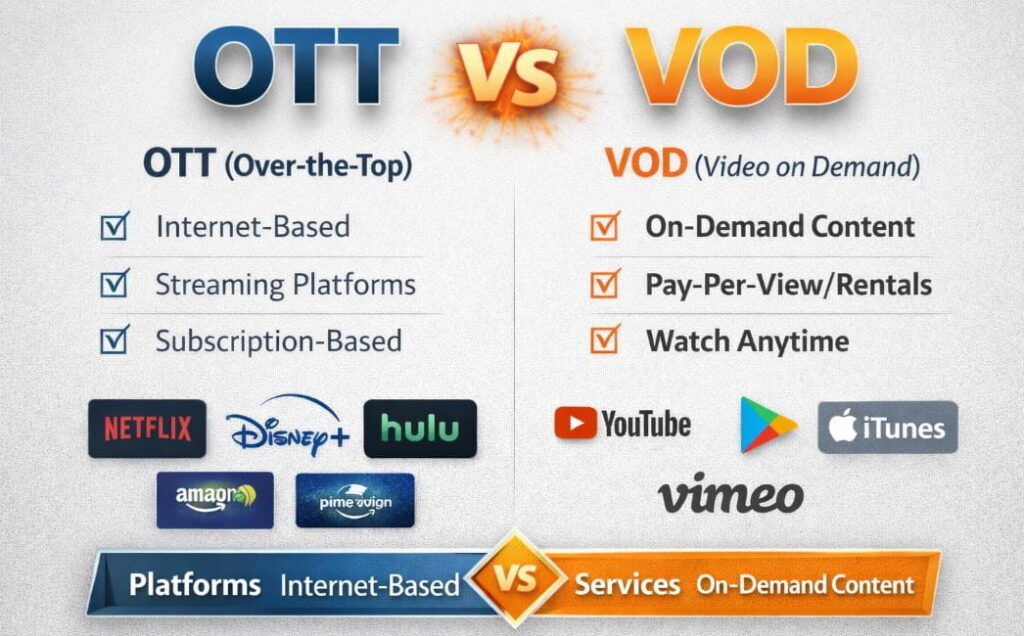
OTT (Over-the-Top) refers to the method of delivering film, television, and other video content directly to viewers via the internet, bypassing traditional distribution channels like cable, broadcast, or satellite television providers. Think of OTT as the highway—the infrastructure that transports content to your screen.
Core Characteristics of OTT Services
- Internet-First Delivery: Content is streamed or downloaded exclusively through an internet connection.
- Device Agnosticism: Accessible across smartphones, smart TVs, tablets, gaming consoles, and computers.
- Diverse Business Models: Primarily operates through:
- SVOD (Subscription Video on Demand): Unlimited access for a recurring fee (e.g., Netflix).
- AVOD (Advertising-Based Video on Demand): Free, ad-supported content (e.g., Pluto TV).
- TVOD (Transactional Video on Demand): Pay-per-view or rental model (often housed within platforms).
- Content Aggregation: Typically offers vast libraries mixing licensed, original, and live content.
Leading OTT Platform Examples: Netflix, Disney+, Amazon Prime Video, Hulu, HBO Max, Paramount+, Peacock.
OTT platforms have become content powerhouses, investing billions in original productions and sophisticated recommendation algorithms to keep viewers engaged.
Decoding VOD: The Engine of Viewer Control
VOD (Video on Demand) is not a platform, but a service model that allows users to select and watch video content at their convenience, free from fixed broadcast schedules. If OTT is the highway, VOD is the on-demand delivery truck—it’s about the “what” and “when” of content consumption.
Defining Features of VOD
- User-Controlled Playback: Instant access to play, pause, rewind, and watch content on a self-determined timeline.
- Transactional Flexibility: Often associated with pay-per-view, electronic sell-through (buying digital copies), or short-term rentals.
- Niche & Specialized Content: A vital outlet for independent films, documentaries, and specialty programming.
- Integration as a Feature: VOD frequently exists as a component within larger OTT platforms (e.g., renting a new release on Amazon Prime Video).
Prominent VOD Service Examples: iTunes/Apple TV, Google Play Movies & TV, YouTube (for rentals/purchases), Vimeo On Demand, cable provider VOD libraries.
VOD empowers choice, turning the viewer into their own programmer.
Head-to-Head: The Critical Differences Between OTT and VOD
| Feature | OTT (Over-the-Top) | VOD (Video on Demand) |
|---|---|---|
| Primary Definition | A distribution method for delivering content via the internet. | A content access model allowing playback at any time. |
| Core Relationship | The platform or “pipe” that delivers content. | A type of service often provided on an OTT platform. |
| Content Access | Typically offers broad libraries via subscription; may include live TV, originals, and licensed catalogs. | Focused on individual title access—rent, buy, or watch as part of a limited library. |
| Business Model | Centered on subscriptions (SVOD) or ads (AVOD). | Centered on transactions (TVOD) or rentals; can be part of a subscription. |
| Best For | Continuous engagement, discovery, and habitual viewing (“What should I watch?”). | Intentional, specific viewing (“I want to watch this specific movie tonight.”). |
| User Commitment | Often a recurring monthly subscription. | Typically a one-time transaction or rental period. |
The Simplest Analogy
All VOD can be delivered via OTT, but not all OTT is exclusively VOD. OTT platforms like Hulu may offer VOD libraries and live TV streaming.
Strategic Benefits: Choosing Between OTT and VOD Models
Advantages of OTT Platforms
- Unparalleled Convenience: Stream anywhere, anytime, on any connected device.
- Content Discovery: Curated libraries and algorithmic recommendations encourage exploration.
- Cost-Effective for Heavy Users: A flat fee provides unlimited access to vast content volumes.
- Integrated Experience: Often combines movies, series, originals, and sometimes live events in one app.
Advantages of VOD Services
- Financial Flexibility: Pay only for what you watch, with no recurring subscription required.
- Immediate Access to New Releases: Often the fastest digital way to rent premium theatrical releases.
- Support for Niche Creators: A vital revenue model for independent filmmakers and specialists.
- Ownership Potential: Some VOD transactions allow permanent digital ownership (Electronic Sell-Through).
How OTT and VOD Work Together?
The modern streaming landscape is defined by convergence. Most major OTT platforms seamlessly incorporate VOD options. For example:
- Amazon Prime Video offers its SVOD library and a “Store” section to rent or buy movies not included in the subscription.
- YouTube functions as a giant AVOD platform, a TVOD rental service, and an OTT service via YouTube Premium and YouTube TV.
This hybrid approach gives consumers ultimate choice: subscribe for breadth or transact for specificity.
Decision Matrix: Is OTT or VOD Right for You?
Your ideal choice depends entirely on your consumption profile:
- For the Binge-Watcher & Constant Viewer: An OTT Subscription (SVOD) is economically and practically superior. The value from unlimited access is clear.
- For the Occasional Viewer & New-Release Hunter: VOD Rentals (TVOD) prevent paying for unused subscriptions and provide immediate access to the latest titles.
- For the Cord-Cutter Seeking Live TV: Look for OTT Live TV Services (e.g., Hulu + Live TV, YouTube TV) that blend live channels with VOD libraries.
- For the Content Creator: OTT Platforms offer massive audiences and subscription revenue share, while VOD Marketplaces (like Vimeo On Demand) enable direct sales and higher per-unit revenue.
Read also more related topics: IPTV VS Sling TV
Frequently Asked Questions (FAQ)
Is Netflix an OTT or a VOD service?
Netflix is an OTT platform. Its core service is a SVOD (Subscription VOD) model, which is a type of VOD service delivered over-the-top.
Can a service be both OTT and VOD?
Yes, and most are. The terms describe different aspects: OTT describes how it’s delivered (via internet), and VOD describes how it’s accessed (on-demand). A platform like Disney+ is an OTT service providing VOD content.
What about free services like YouTube or Tubi?
These are AVOD (Advertising-Based VOD) models delivered via OTT. They are free to the user because advertising revenue supports them.
Which is more profitable for filmmakers?
It depends. OTT SVOD deals offer guaranteed licensing fees and massive exposure. VOD transactions (TVOD) can offer higher per-unit revenue and are crucial for independent and niche film sustainability.
Is the future OTT or VOD?
The future is both, deeply integrated. The winning strategy for platforms is to offer hybrid models—subscriptions for loyalty and volume, plus transactional options for immediacy and premium content.
The Bottom Line
OTT and VOD are the twin engines of the streaming revolution. OTT represents the paradigm shift in distribution, breaking the gatekeeper control of traditional TV. VOD represents the paradigm shift in consumer behavior, granting ultimate control over viewing time and choice.
For the viewer, this means unprecedented freedom. For the industry, it means continuous innovation. By understanding their distinct roles and powerful synergy, you can better navigate the expansive, on-demand world of modern entertainment—whether you’re aiming to find the perfect movie tonight or build the next great streaming platform.